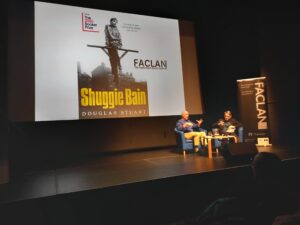
A conversation and Q&A chaired by Kevin MacNeil, followed by a book signing in our foyer.
Copies will be available to purchase from our shop.
Everything he owned fit into a backpack and one doubled bin bag. It had taken him less than ten minutes to pack up four years of his life. It had taken a little longer to fold himself away, to hide all the bits of himself that had slowly been unfurling since he had arrived on the mainland. In truth, he had not changed that much since he had been at college, and as he roamed the ferry he wondered if he had always known he would be forced to come home eventually.
Out of money and with little to show for his art school years on the mainland, John-Calum Macleod takes the ferry home, called back by his father to the island of Harris. In the windswept croft in which he grew up, Cal reluctantly resumes his old life, caught between the two poles of his childhood: his father John, a sheep farmer, weaver, and pillar of the local Presbyterian church, and his Glaswegian grandmother Ella who has kept a faltering peace with her son-in-law for decades.
While Cal wonders if any lonely men might be found on the island’s hillsides, back in a tight-knit Hebridean community where talk is both social currency and a tool for control, and where a rigid adherence to Presbyterian faith clashes with the unspoken desires of its inhabitants, John is dismayed by his son’s long hair and seeming unwillingness to be Saved. As the seasons pass, everything is poised to change as the threads holding the community together become increasingly entangled.
In a narrative both tender and unflinching, Douglas Stuart continues and deepens his exploration of masculinity and the silent struggle of lives lived under a watchful, judgmental eye. John of John examines the weight of family expectation, the painful compromises people make for love, the lies they tell themselves and one another in order to survive, and the profound cost of a life unlived. It confirms Douglas Stuart’s reputation as one of the most vital voices in contemporary fiction.
‘John of John has the emotional range and sense of sympathy of Douglas Stuart’s earlier novels, but this book is special, it has an urgency, an immediacy, a brilliant sense of place, the drama of fierce emotion repressed, concealed and volcanically exposed.’ COLM TÓIBÍN
‘To read John of John is to move to the Isle of Harris and take up residence in the family croft. The novel is so immersive, so all-encompassing, that I felt like I was living in it. Douglas Stuart has written something brilliant and rare.’ ANN PATCHETT
‘John of John is another mesmeric, transportive, vividly sensory and astonishingly textured novel from one of our greatest writers.’ BERNARDINE EVARISTO
‘John of John is Douglas Stuart’s finest novel yet, and that is saying something . . . he infuses his narrative with an authentic understanding of the essence of Hebridean identity; he creates a novel that has the grandeur of classical literature but the readability and relatability of a contemporary masterpiece . . . Epic and intimate, this is the kind of novel that enlarges your very capacity for empathy.’ KEVIN MACNEIL
‘Douglas Stuart explores the visible and invisible chains of love forged between a parent and child — as each grapples with his respective faith and complex humanity. Stuart’s characters yearn and yield tenderly as they struggle with fate and free will. The inimitable world of John of John is passionate, liberating, and gorgeous.’ MIN JIN LEE
‘A profound and unflinching exploration of masculinity, sexuality, faith, and the haunting weight of heritage on the human soul. Set against the stark beauty of the Hebrides, where the landscape, in all its colour and texture, is as alive and commanding as its people, this novel delves into paternal silence, love and loneliness, and the unsettling sense that we are never truly unwatched. Written in timeless prose, it speaks with urgent relevance. No one crafts characters with the depth and precision of Stuart — John of John is a masterpiece.’ ELAINE FEENEY
‘Breathtaking, life affirming, transcendent storytelling. John of John shows Stuart to be a true and abiding talent’ KIRAN MILLWOOD HARGRAVE ‘John of John is a fierce, glorious sting of a novel. Douglas Stuart has somehow lifted the rocky, windswept landscape of the Scottish Western Isles — as well as its externally stark and thwarted, if internally blazing, characters — and replicated both with utter flawlessness on the page. What an astonishing feat of literary fiction.’ LAUREN GROFF
Douglas Stuart was born and raised in Glasgow. After graduating from the Royal College of Art, he moved to New York where he began a career in fashion design.
Shuggie Bain, his first novel, won the Booker Prize and both Debut of the Year and Book of the Year at the British Book Awards. It was also shortlisted for the National Book Award, and in 2025 was selected by The Sunday Times as one of the ‘best novels of the twenty-first century’ as well as one of the ten best Booker winners of all time by the Daily Telegraph. His second novel, Young Mungo, was a number one Sunday Times bestseller. His short stories have appeared in The New Yorker, and ‘Love, Hope & Grit’, the Imagine documentary Douglas made with the late Alan Yentob, is available on the BBC iPlayer. Douglas Stuart lives in New York.